


Page 48 - CII-ARTHA
P. 48
ARTHA


          Educated Women Face the Highest Unemployment Rate


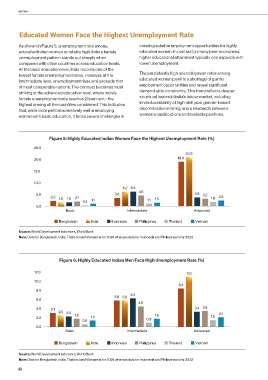
         As shown in Figure 5, unemployment rate among         creating suitable employment opportunities for highly
         educated Indian women is notably high. India’s female   educated women. In contrast, in many peer economies,
         unemployment pattern stands out sharply when          higher educational attainment typically corresponds with
         compared with other countries across education levels.  lower unemployment.
         At the basic education level, India records one of the
         lowest female unemployment rates. However, at the     The persistently high unemployment rates among
         intermediate level, unemployment rises and exceeds that   educated women point to a shortage of gainful
         of most comparable nations. The contrast becomes most   employment opportunities and reveal significant
         striking at the advanced education level, where India’s   demand-side constraints. This trend reflects deeper
         female unemployment rate reaches 21 per cent - the    structural issues in India’s labour market, including
         highest among all the countries considered. This indicates   limited availability of high-skill jobs, gender-based
         that, while India performs relatively well in employing   discrimination in hiring, and a mismatch between
         women with basic education, it faces severe challenges in   women’s qualifications and available positions.


                       Figure 5: Highly Educated Indian Women Face the Highest Unemployment Rate (%)
                25.0
                                                                                   20.9
                20.0                                                            19.0

                15.0

                10.0
                                                        6.2 6.3
                                                               4.6
                 5.0                                3.6                                3.8  3.2
                        2.3       2.1                                                          1.8  2.5
                           1.6  1.6       1.1                      1.1  1.5
                                      0.4
                 0.0
                              Basic                       Intermediate                 Advanced

                           Bangladesh    India     Indonesia   Philippines  Thailand    Vietnam

         Source: World Development Indicators, World Bank
         Note: Data for Bangladesh, India, Thailand and Vietnam is for 2024 whereas data for Indonesia and Philippines is for 2022


                           Figure 6: Highly Educated Indian Men Face High Unemployment Rate (%)


                12.0                                                                11.0
                10.0
                                                                                8.4
                 8.0
                                                           6.3
                                                    5.8 5.8
                 6.0
                                                               4.5
                 4.0    3.1                                                            3.4 3.5
                           2.5  2.3                                                               2.1
                 2.0              1.8    1.4                      0.9  1.8                     1.5
                                      0.6
                 0.0
                              Basic                       Intermediate                 Advanced

                           Bangladesh    India     Indonesia   Philippines  Thailand    Vietnam


         Source: World Development Indicators, World Bank
         Note: Data for Bangladesh, India, Thailand and Vietnam is for 2024 whereas data for Indonesia and Philippines is for 2022

         48

