


Page 10 - CII-ARTHA
P. 10
ARTHA


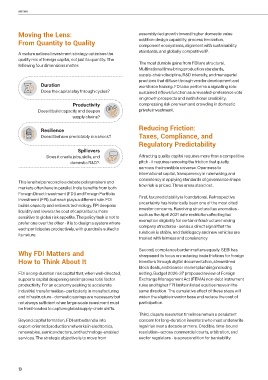
         Moving the Lens:                                      assembly-led growth toward higher domestic value

         From Quantity to Quality                              addition: design capability, process innovation,
                                                               component ecosystems, alignment with sustainability
                                                               standards, and globally competitive IP.
         A mature national investment strategy optimises the
         quality mix of foreign capital, not just its quantity. The
         following four dimensions matter:                     The most durable gains from FDI are structural.
                                                               Multinational firms bring production standards,
                                                               supply-chain discipline, R&D intensity, and managerial
                                                               practices that diffuse through vendor development and
                   Duration                                    workforce training. FDI also performs a signalling role:
                   Does the capital stay through cycles?       sustained inflows function as a revealed-preference vote
                                                               on growth prospects and institutional credibility,
                                 Productivity                  compressing risk premium and crowding in domestic
                  Does it build capacity and deepen            private investment.
                                 supply chains?
                                                               Reducing Friction:
                   Resilience
                   Does it behave predictably in a shock?      Taxes, Compliance, and
                                                               Regulatory Predictability
                                    Spillovers
                      Does it create jobs, skills, and         Attracting quality capital requires more than a competitive
                                domestic R&D?.                 pitch - it requires removing the friction that quietly
                                                               narrows the investible universe. Openness to
                                                               international capital, transparency in rulemaking, and
                                                               consistency in applying standards of governance shape
         This lens helps reconcile a debate policymakers and
         markets often have in parallel. India benefits from both   how risk is priced. Three areas stand out.
         Foreign Direct Investment (FDI) and Foreign Portfolio
         Investment (FPI), but each plays a different role. FDI   First, tax predictability is foundational. Retrospective
         builds capacity and embeds technology. FPI deepens    uncertainty has historically been one of the most cited
         liquidity and lowers the cost of capital but is more   investor concerns. Resolving structural tax anomalies -
         sensitive to global risk appetite. The policy task is not to   such as the April 2021 date restriction affecting tax
         prefer one over the other - it is to design a system where   exemption eligibility for certain infrastructure holding
         each participates productively, with guardrails suited to   company structures - sends a direct signal that the
         its nature.                                           rulebook is stable, and that legacy and new vehicles are
                                                               treated with fairness and consistency.


         Why FDI Matters and                                   Second, compliance burden matters equally. SEBI has
                                                               sharpened its focus on reducing trade frictions for foreign
         How to Think About It                                 investors through digital documentation, streamlined
                                                               block deals, and cleaner market plumbing including
         FDI is long-duration risk capital that, when well-directed,   netting. Budget 2026-27 proposed review of Foreign
         supports capital deepening and improves total factor   Exchange Management Act (FEMA) non-debt instrument
         productivity. For an economy seeking to accelerate    rules and higher FPI limits in listed equities move in the
         industrial transformation - particularly in manufacturing   same direction. The cumulative effect of these steps will
         and infrastructure - domestic savings are necessary but   widen the eligible investor base and reduce the cost of
         not always sufficient when large-scale investment must   participation.
         be front-loaded to capture global supply-chain shifts.
                                                               Third, dispute resolution timelines remain a persistent
         Beyond capital formation, FDI embeds India into       concern for long-duration investors who must underwrite
         export-oriented production networks in electronics,   legal risk over a decade or more. Credible, time-bound
         renewables, semiconductors, and technology-enabled    resolution - across commercial courts, arbitration, and
         services. The strategic objective is to move from     sector regulators - is a precondition for bankability.


         10

